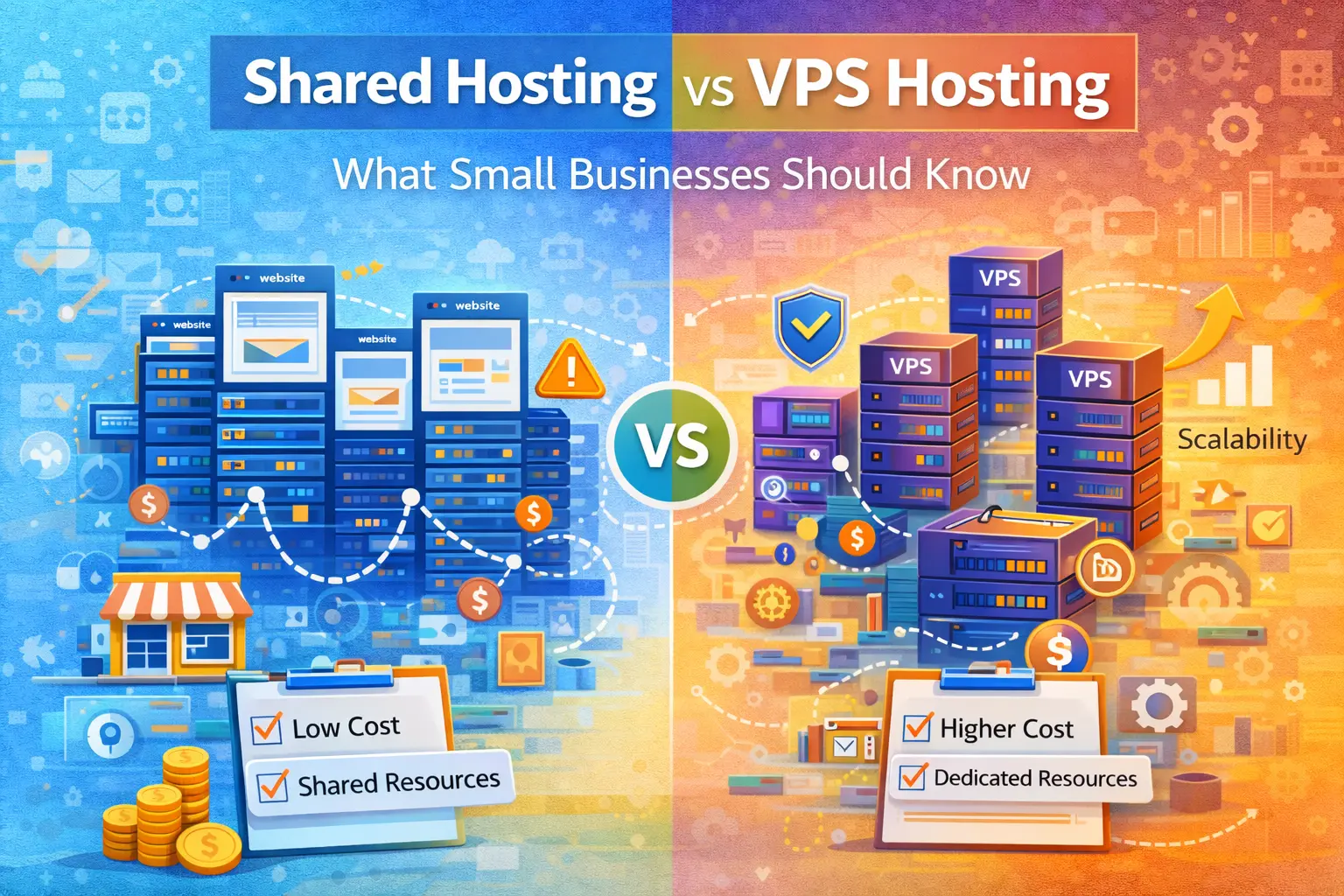
Shared Hosting vs VPS Hosting: What Small Businesses Should Know
Introduction
When launching a business website, one of the first technical decisions you must make is choosing a hosting environment. For many small businesses, the choice often comes down to shared hosting or VPS hosting. At first glance, both options allow your website to go live on the internet. However, the difference lies in how server resources are allocated, how performance is managed, and how scalable your infrastructure can become as your business grows. Understanding this difference prevents performance issues, security risks, and unexpected migration costs later.
What Is Web Hosting?
Before comparing shared and VPS hosting, it is important to understand what hosting actually does. Web hosting is the service that stores your website’s files, images, databases, and application code on a server connected to the internet. When someone types your domain name into their browser, that server delivers your website content. If your domain name is the address, hosting is the building that stores your operations.
The quality of your hosting directly affects website speed, uptime, and reliability.
What Is Shared Hosting?
Shared hosting means your website shares a single physical server with multiple other websites. Imagine renting an apartment in a large building. You have your own space, but you share resources such as electricity, water, and infrastructure with other tenants. In hosting terms, this means your website shares:
-
CPU processing power
-
Memory (RAM)
-
Storage
-
Bandwidth
Because costs are distributed across many users, shared hosting is typically the most affordable option.
It is suitable for:
-
Small websites
-
Low traffic volumes
-
Informational business pages
-
Startups testing online presence
However, performance can be affected if another website on the same server experiences high traffic or security issues.
What Is VPS Hosting?
VPS stands for Virtual Private Server. Although multiple websites still exist on one physical server, each website operates within its own isolated virtual environment. Think of VPS hosting like owning a townhouse within a complex. You share the land, but your utilities and infrastructure are separate.
This isolation means:
-
Dedicated resource allocation
-
Improved performance consistency
-
Greater control over server configuration
-
Enhanced security
VPS hosting is typically recommended for:
-
Growing businesses
-
E-commerce platforms
-
Websites with moderate to high traffic
-
Businesses running custom applications
Performance Differences
Website speed affects user experience and search engine rankings. According to Google research, as page load time increases from one second to three seconds, the probability of bounce increases by 32 percent (Google, 2018). Shared hosting can be slower during peak traffic periods because resources are distributed among many users. VPS hosting provides more consistent performance since allocated resources are reserved for your environment. For businesses that rely on lead generation or online transactions, performance reliability matters.
Security Considerations
In shared hosting environments, vulnerabilities on one website can potentially impact others on the same server if security isolation is weak.
Reputable hosting providers implement security controls, but shared environments inherently carry more risk.
VPS hosting offers stronger isolation. Even if another VPS user encounters a security issue, your environment remains separated.
For businesses handling customer data or payment information, enhanced security may justify higher hosting costs.
Scalability and Growth
Small businesses often start with limited traffic but aim to grow.
Shared hosting plans typically have fixed resource limits. If traffic increases significantly, performance may decline.
VPS hosting allows easier resource scaling. Additional RAM, storage, or processing power can often be added without migrating to an entirely new server.
Planning for scalability reduces disruption during growth phases.
Cost Comparison
Shared hosting is generally the most affordable hosting option. It provides an accessible entry point for businesses establishing an online presence.
VPS hosting costs more because resources are partially dedicated and infrastructure management is more complex.
However, cost should be evaluated in context. Downtime, slow performance, and security breaches can carry higher indirect costs.
Hosting decisions should align with operational importance rather than price alone.
Which One Should a Small Business Choose?
If your business website is primarily informational, with low traffic and limited functionality, shared hosting may be sufficient.
If your business:
-
Processes online payments
-
Runs automation systems
-
Integrates CRM tools
-
Receives consistent traffic
-
Plans for rapid growth
Then VPS hosting offers stronger long-term stability.
Infrastructure should match business ambition.
Conclusion
Shared hosting and VPS hosting both enable websites to operate online, but they serve different business needs.
Shared hosting offers affordability and simplicity. VPS hosting provides performance stability, scalability, and enhanced security.
Small businesses should view hosting not merely as a cost decision, but as foundational infrastructure.
Reliable hosting supports credibility, customer experience, and sustainable growth.
Frequently Asked Questions
Tags:


Comments (0)
No comments yet. Be the first to share your thoughts!
Leave a Comment
Subscribe to Our Newsletter
Get the latest insights on digital transformation delivered to your inbox
