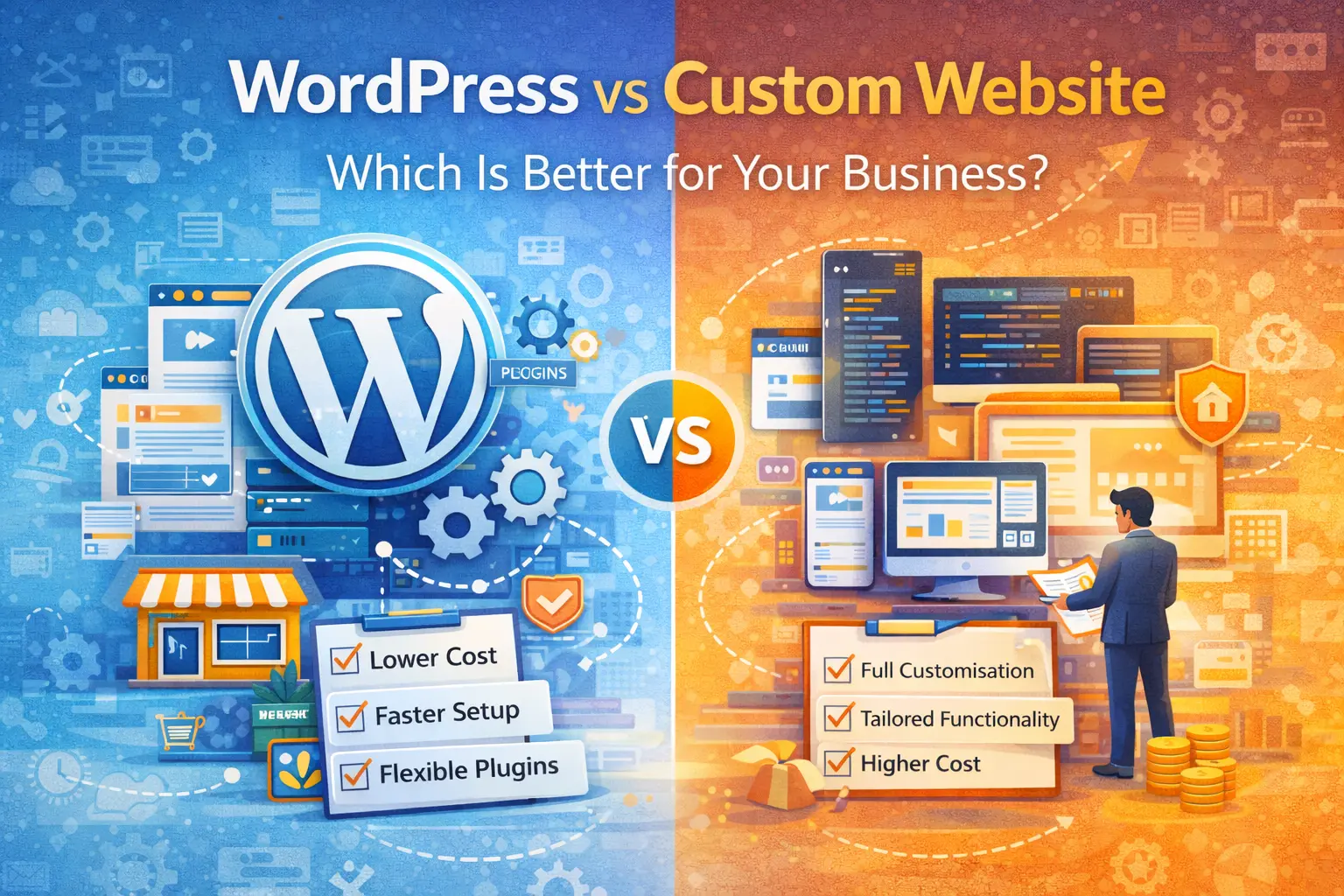
WordPress vs Custom Website: Which Is Better for Your Business?
Introduction
One of the most common questions business owners face when building a website is whether to use WordPress or invest in a fully custom-built solution. At a surface level, both options allow you to create a professional website. However, they differ significantly in terms of flexibility, cost, scalability, development time, and long-term control. Understanding these differences helps you avoid overbuilding or underbuilding your digital infrastructure. Choosing the right foundation matters.
What Is a WordPress Website?
A WordPress website is built using a content management system that provides a structured framework for creating and managing content.
It operates using:
-
Themes for design
-
Plugins for functionality
-
A database for storing content
-
A dashboard for management
Because WordPress is open-source and widely supported, it has become one of the most popular website platforms globally. According to W3Techs (2024), WordPress powers over 43 percent of all websites worldwide. This widespread adoption reflects its flexibility and accessibility. WordPress allows businesses to launch websites relatively quickly without building every feature from scratch.
What Is a Custom Website?
A custom website is developed from the ground up using programming languages such as PHP, JavaScript frameworks, or other backend technologies. Instead of relying on pre-built themes or plugins, developers design and code functionality specifically tailored to business requirements.
Custom development provides:
-
Full architectural control
-
Tailored database structures
-
Unique user interfaces
-
Advanced system integrations
However, this level of control requires more development time, higher initial investment, and ongoing technical maintenance.
Cost Considerations
For most small businesses, budget is a primary factor. WordPress generally has lower upfront costs because:
-
Core software is free
-
Themes are pre-built
-
Plugins extend functionality
-
Development time is shorter
Custom websites require more development hours, testing, and architecture planning, which increases initial investment. However, lower cost does not always mean better value. The decision should align with business complexity.
Flexibility and Customisation
WordPress is highly flexible within its ecosystem. With thousands of plugins available, businesses can add:
-
E-commerce functionality
-
Booking systems
-
Membership portals
-
SEO tools
-
Marketing automation
However, WordPress still operates within a framework.
Custom websites offer unrestricted flexibility because they are built without predefined structures. This is beneficial when:
-
Business logic is complex
-
Unique workflows are required
-
Highly specific integrations are necessary
The question becomes: does your business require that level of customization?
Scalability
Scalability refers to how easily a website can grow alongside your business. WordPress can scale effectively when properly configured and hosted on strong infrastructure. Many large organisations use WordPress successfully. However, extremely high-traffic platforms or complex SaaS applications may eventually require custom architecture for optimal performance. Scalability depends less on the platform itself and more on system design.
Security Considerations
Security depends on implementation.
WordPress vulnerabilities often arise from:
-
Outdated plugins
-
Poor hosting environments
-
Weak passwords
According to Sucuri’s Website Threat Research Report (2023), outdated plugins remain a leading cause of WordPress compromises. Custom websites can also have vulnerabilities if poorly coded. Security is not determined solely by platform choice but by maintenance discipline and development standards.
Development Time
WordPress websites can often be deployed faster because the framework already exists.
Custom development takes longer because functionality must be coded, tested, and refined from scratch.
For businesses needing rapid deployment, WordPress may offer practical advantages.
For businesses building highly specialised systems, custom development may be justified.
Maintenance and Long-Term Management
WordPress requires regular updates to:
-
Core software
-
Themes
-
Plugins
These updates maintain security and performance.
Custom websites also require maintenance, particularly if built with evolving frameworks.
In both cases, structured digital management is essential.
No website is “set and forget.”
When WordPress Is the Right Choice
WordPress is often appropriate when:
-
The website is primarily informational
-
E-commerce requirements are standard
-
Budget constraints exist
-
Speed to market is important
-
Content management flexibility is required
It provides a strong balance between cost and capability.
When Custom Development Is the Right Choice
Custom development becomes appropriate when:
-
Business processes are highly unique
-
Integration requirements are complex
-
Scalability demands are extreme
-
Platform ownership control is critical
It supports enterprise-level system architecture.
Strategic Perspective
The decision between WordPress and custom development should not be based on trends or assumptions.
It should follow structured system analysis.
Technology should serve operational strategy, not replace it.
The most effective solution is the one aligned with business objectives, operational complexity, and long-term growth plans.
Conclusion
WordPress and custom development are not competitors in every scenario. They are tools suited for different levels of complexity.
WordPress offers flexibility, speed, and affordability.
Custom development offers architectural freedom and tailored functionality.
The right choice depends on structured analysis, not assumption.
Technology decisions should align with operational strategy and future scalability.
References
W3Techs (2024). Usage statistics of WordPress. https://w3techs.com/technologies/details/cm-wordpress
Sucuri (2023). Website Threat Research Report. https://sucuri.net/reports/
Frequently Asked Questions
Tags:
Comments (0)
No comments yet. Be the first to share your thoughts!
Leave a Comment
Subscribe to Our Newsletter
Get the latest insights on digital transformation delivered to your inbox
